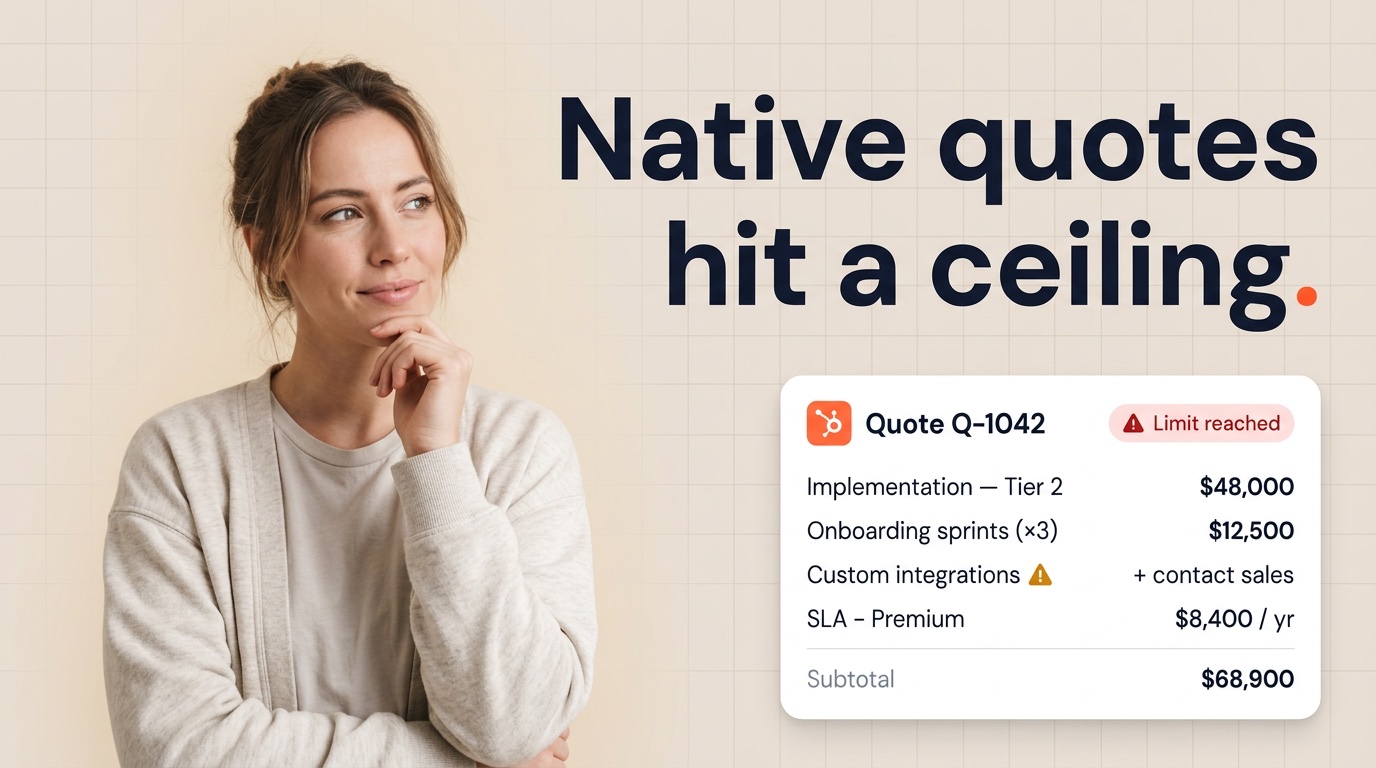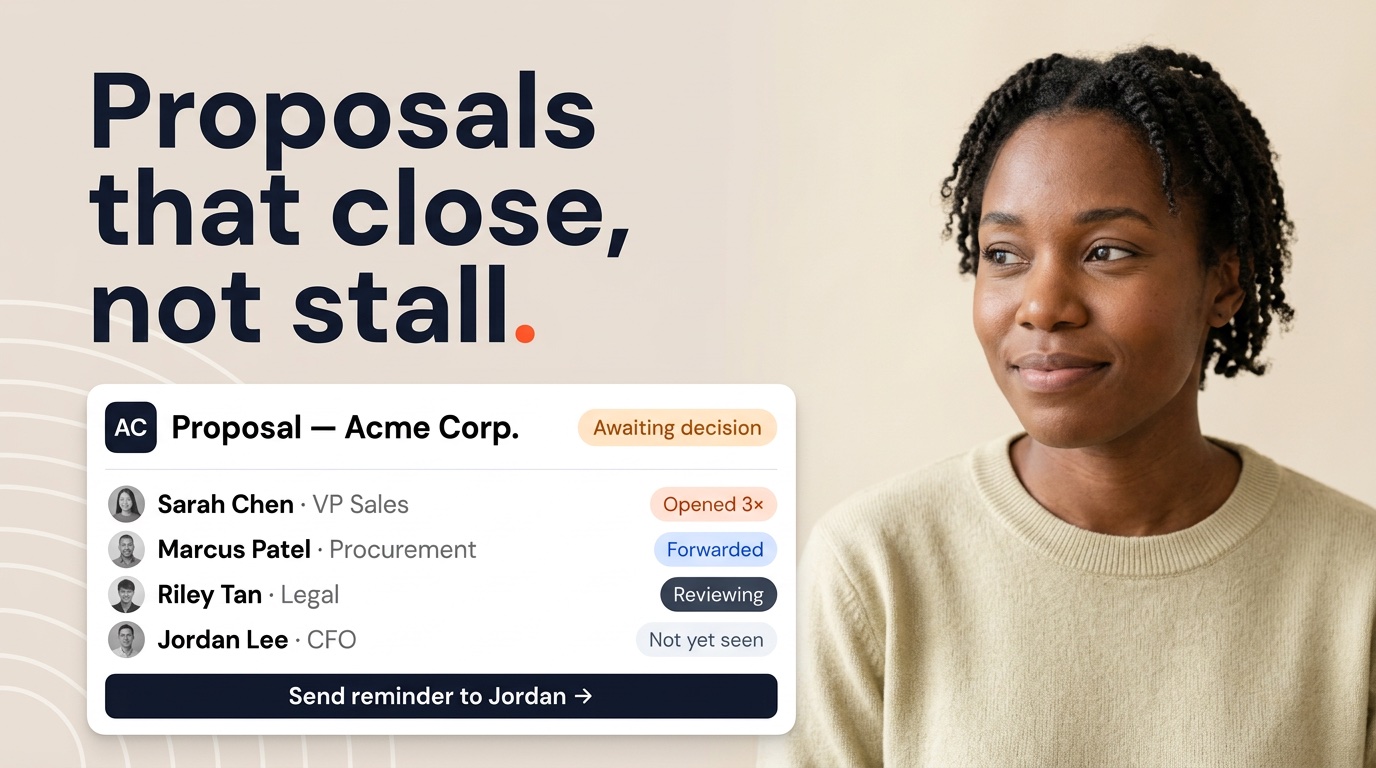


Zoho Sign is a solid, affordable eSign tool — but it was built for teams inside the Zoho ecosystem, not HubSpot. If you're running HubSpot as your CRM, there's no native integration: connecting Zoho Sign requires Zapier or a third-party connector, and even then, it only handles the signature step. Zoho Sign can't generate a quote or contract from your HubSpot deal data, it can't route documents through an approval workflow, and it can't save signed copies back to HubSpot as records your pipelines and reports can act on.
I work at Portant, so I'll be upfront about that. But I also spend a lot of time inside customer HubSpot portals, and I understand why teams using Zoho Sign alongside HubSpot end up building awkward workarounds. This article evaluates 10 alternatives honestly — including where each one beats Portant and where it doesn't. I've scored them on four criteria: HubSpot integration depth, template flexibility, pricing at a five-user team, and end-to-end document workflow.
Why HubSpot teams look for Zoho Sign alternatives
The friction with Zoho Sign on HubSpot falls into three clear categories. The first is the integration gap: Zoho Sign is tightly woven into Zoho CRM, but for HubSpot users it's essentially a standalone tool that talks to HubSpot only via Zapier. Setting up that bridge takes time, it breaks occasionally, and it still doesn't give you HubSpot field data populating your documents automatically.
The second is that Zoho Sign is a signing layer, not a document automation platform. You still have to build the quote, proposal, or contract yourself — manually — before Zoho Sign can do anything with it. Teams that send more than a handful of deals per week quickly feel that manual document preparation as a bottleneck.
The third is the broader ecosystem mismatch. Zoho Sign is optimised for Zoho CRM users: its templates, its triggers, its native integrations all assume the Zoho suite as the source of truth. If HubSpot is your system of record, you're using a tool that's fighting its own assumptions every time you try to connect the two.
Quick comparison
| Tool | Best for | HubSpot integration | Starting price | Free plan | G2 |
|---|---|---|---|---|---|
| Portant | HubSpot-native doc automation | Native (certified app) | $42/mo workspace | Yes (30 credits/mo) | 4.7/5 |
| PandaDoc | Editor-first proposals + eSign | Integration (sync) | $49/user/mo | No (14-day trial) | 4.7/5 |
| Proposify | Editor-first proposals | Integration (sync) | $49/user/mo | No (14-day trial) | 4.6/5 |
| Qwilr | Interactive web proposals | Integration (sync) | $35/user/mo | No (14-day trial) | 4.5/5 |
| DocuSign | Enterprise eSign compliance | Connector (envelope sync) | $45/user/mo | No (30-day trial) | 4.5/5 |
| Dropbox Sign | Lightweight eSign | Integration (sync) | $20/user/mo | No (30-day trial) | 4.7/5 |
| GetAccept | Sales engagement + docs | Integration (sync) | Custom pricing | No | 4.6/5 |
| SignNow | Affordable eSign for teams | Integration (sync) | $8/user/mo | No (30-day trial) | 4.7/5 |
| HubSpot Quotes | Free native quotes | Native (built into HubSpot) | $0 with Sales Hub | Yes | 4.4/5 |
| Signaturely | Simple, affordable eSign | Via Zapier | From $25/mo | No (3 free requests) | 4.8/5 |
G2 ratings as of May 2026. Prices shown are billed annually where applicable — check each vendor's site for current rates.
 1. Portant — best for HubSpot-native document automation
G2: 4.7/5 · From $42/mo workspace · Free plan: Yes (30 credits/mo)
Portant is purpose-built for teams that use HubSpot as their primary system of record and want the entire document lifecycle to live there too — not alongside it in a separate tool that only communicates through Zapier. It's the #1 HubSpot-certified document automation app, used by over 920,000 people, and it was designed from the ground up to work the way HubSpot works.
The gap between Portant and Zoho Sign isn't a feature gap — it's a workflow gap. Zoho Sign assumes you'll prepare a document somewhere else, upload it, collect a signature, and then figure out how to get the result back into your CRM. Portant eliminates all of that. A deal reaches a certain stage in HubSpot, Portant generates the relevant document automatically from your Google Docs or Word template, merges in all the deal and contact data, routes it for internal approval if needed, sends it for signature, and saves the signed copy back to the HubSpot deal record — all without anyone leaving HubSpot or managing a Zapier connection.
The template story is also materially different. Zoho Sign expects an uploaded PDF or Word file — you prepare the document, then bring it in. Portant uses your existing Google Docs, Slides, Word, or PowerPoint files as live templates. Merge tags pull in deal, contact, company, line item, and custom property data. If your legal team has already approved a template layout, it goes to work in Portant the same day. No rebuilding, no proprietary editor to learn, no migration project.
For teams that send high volumes — proposals, quotes, contracts, NDAs, onboarding packets — Portant's automation triggers are where the real time savings appear. A HubSpot workflow step can kick off document generation from a deal stage change, a form submission, or any workflow trigger your ops team has configured. The entire outbound process can run without manual intervention, and every document that's been generated, sent, opened, and signed is visible on the deal record and reportable through standard HubSpot reports.
Key features
- Generates documents from live HubSpot deal, contact, company, and line item data
- Templates in Google Docs, Slides, Word, PowerPoint, or PDF — no proprietary editor
- Every document saved back to HubSpot as its own record
- Sequential approval workflows with one-click approve/reject from inside HubSpot
- Built-in eSignature on paid plans — status updates HubSpot at each signing step
- Automation triggers: generate documents from deal stage changes, form submissions, or workflows
- Conditional content logic — show/hide sections based on HubSpot field values
- Dynamic line item tables pulled directly from HubSpot products
Pros
- Flat workspace pricing means your whole team is covered without per-seat penalties
- No template migration — your existing Google Docs and Word files work from day one
- Documents as HubSpot records means reporting, list-building, and workflow automation all work natively
- The full workflow — generate, approve, sign, store — stays inside HubSpot without Zapier
Cons
- No visual drag-and-drop builder — if reps want to design rich layouts from scratch inside the tool, the template-file approach is less visual than PandaDoc or Proposify
- Document volume limits apply on lower plans (30 credits/mo free, 2,000/mo on Pro)
Pricing: Free (30 credits/mo), Pro $42/mo workspace (2,000 docs/mo, billed annually), Team $125/mo (5 users, 5,000 credits/mo). No per-seat pricing on the Pro plan — your whole team is included.
For a 5-person team: $42/mo on Portant Pro vs $60/mo for Zoho Sign Professional (5 users) — plus the cost of a separate document tool and Zapier to make the whole workflow actually work.
For a detailed side-by-side, our Portant vs Zoho Sign comparison page covers features, pricing, and integration depth in full.
 2. PandaDoc — best for editor-first proposals and contracts
G2: 4.7/5 · From $49/user/mo · Free plan: No (14-day trial)
PandaDoc is the category benchmark for document automation with a built-in editor. It covers the full workflow Zoho Sign doesn't: create, send, sign, and track documents without uploading anything from somewhere else. For teams that want to build polished proposals inside a dedicated tool — drag-and-drop sections, interactive pricing tables, embedded media — PandaDoc is one of the most mature options available.
The HubSpot integration syncs deal data into PandaDoc documents and logs activity back to the CRM. It works well for pulling in contact and company fields, though deal status and document events live primarily in PandaDoc rather than as first-class HubSpot properties. Teams that rely on HubSpot dashboards and workflow automation for pipeline visibility will still need to check PandaDoc for document-level details.
Key features
- Visual block-based editor with drag-and-drop sections, a reusable content library, and brand kit
- Interactive pricing tables with configurable options for buyers
- Built-in eSignature with audit trail and multi-signatory support
- HubSpot integration: deal and contact data in, activity and status back out
- Approval workflows and document analytics (open time, section views)
Pros
- Full document creation platform — no separate tool needed for writing, designing, and signing
- Strong content library for teams sending many variations of similar proposals
- Mature, widely-used platform with reliable uptime and strong support documentation
Cons
- Per-seat pricing at $49/user/mo — a 5-person team pays $245/mo, significantly more than Portant's $42/mo flat
- Templates must be built inside PandaDoc's editor — existing Google Docs or Word files can't be imported as live templates
- Document status doesn't write back to HubSpot as properties that workflows can act on natively
Pricing: Business plan at $49/user/month (billed annually). eSign-only plan available from $19/user/mo. No free plan — 14-day trial available.
Best for: teams that need a polished visual editor for proposals and contracts and are comfortable with documents living in a second platform. If you're switching from Zoho Sign specifically because you need document generation, PandaDoc solves that problem — but adds significant per-seat cost as the team grows.
 3. Proposify — best for editor-first proposal creation
G2: 4.6/5 · From $49/user/mo · Free plan: No (14-day trial)
Proposify is a dedicated proposal platform built around a visual block editor, a reusable content library, and structured collaborative review. Where Zoho Sign starts after the document is already finished, Proposify covers the whole creation-to-signature arc. For teams where the proposal itself is a branded sales asset — not just a formality before closing — Proposify's editor is genuinely well-designed.
The HubSpot integration pulls deal data into proposals and logs activity and status back to HubSpot, similar to PandaDoc. Documents live in Proposify, so pipeline reporting requires switching out of HubSpot. For teams where the manager's primary tool is HubSpot dashboards, that trade-off is worth noting.
Key features
- Visual block-based editor with drag-and-drop sections and a reusable content library
- eSignature, interactive pricing tables, and video embedding built in
- Approval workflows and real-time viewer notifications
- HubSpot integration: deal data in, activity and proposal status back out
Pros
- One of the most polished proposal editors available — easier for reps to build beautiful layouts than in most alternatives
- Strong content library for teams that need consistent branded sections across many proposals
- Robust analytics — time spent per section, scroll depth, signer activity
Cons
- Per-seat pricing at $49/user/mo — same cost tier as PandaDoc, expensive for growing teams
- Documents live in Proposify, not HubSpot — managers need to leave the CRM for document status
- Not a native HubSpot app — deeper reporting requires manual effort or third-party connectors
Pricing: Team plan at $49/user/month (billed annually). Includes HubSpot integration, approvals, and analytics. No free plan.
Best for: teams that want a polished editor-first experience for high-stakes proposals, have time to build and maintain a content library, and are comfortable running a second platform alongside HubSpot for document status.
 4. Qwilr — best for interactive web-based proposals
G2: 4.5/5 · From $35/user/mo · Free plan: No (14-day trial)
Qwilr takes a fundamentally different approach to the proposal format: instead of sending a PDF or a document file, buyers receive a responsive webpage. They can navigate sections, accept terms, and sign — all in the browser without downloading anything. For teams where the proposal experience itself is part of the pitch, the format becomes a differentiator that static PDFs can't match.
The HubSpot integration is similar in depth to Proposify: deal data flows into the template, and view, acceptance, and signing events sync back. Documents live in Qwilr's platform, so CRM-side reporting still requires switching tools.
Key features
- Web-based proposal format — interactive, mobile-responsive, no PDF required
- Section-level engagement analytics: which parts buyers read, time spent, scroll depth
- Online acceptance and eSign without an email attachment
- HubSpot integration: deal data in, engagement data and status back out
Pros
- Modern buyer experience that stands out against PDF-based or Zoho Sign-style signed documents
- Section analytics give reps visibility into buyer behaviour that a static document can't provide
- Lower per-seat price than Proposify or PandaDoc at the same feature tier
Cons
- Not all buyers prefer web proposals — procurement teams often require a PDF for internal approvals
- No offline option: if a buyer's internet connection drops, the proposal disappears
- Documents don't live in HubSpot — CRM-side reporting requires going into Qwilr
Pricing: Business plan at $35/user/month (billed annually). Includes HubSpot integration, eSign, and analytics. No free plan.
Best for: creative agencies, high-touch SaaS, and professional services teams where the proposal moment is a key part of the sale and buyers expect a modern digital experience. Less suited to industries where procurement requires a downloadable signed PDF.
 5. DocuSign — best for enterprise eSign compliance
G2: 4.5/5 · From $45/user/mo · Free plan: No (30-day trial)
DocuSign is the category standard for electronic signatures. If your use case is specifically about compliant, auditable signatures on documents that are already finalised somewhere else, DocuSign is the safest choice for enterprise requirements, legal scrutiny, and buyer recognition. Almost every procurement team and enterprise buyer recognises a DocuSign envelope — which matters when that familiarity is part of the trust signal you're sending.
Like Zoho Sign, DocuSign doesn't generate documents from CRM data. You upload a finished PDF or Word document, add signature fields, and send. The HubSpot connector syncs envelope status back — sent, viewed, completed, declined — but it doesn't transform DocuSign into a document automation tool. Teams switching from Zoho Sign because they need document generation won't find that capability here.
Key features
- Industry-standard eSign with SOC 2, ISO 27001, eIDAS, and ESIGN Act compliance
- Granular audit trail — IP address, timestamp, and signer identity for every action
- HubSpot connector: envelope events sync back to deal or contact records
- In-person signing and SMS-based identity verification on higher plans
- Bulk send for high-volume agreement scenarios
Pros
- Widest enterprise recognition — buyers and procurement teams expect it
- Best-in-class compliance certifications for regulated industries
- Reliable and mature platform with a large integrations ecosystem
Cons
- No document generation from CRM data — it only covers the signing step, not the creation step
- HubSpot integration is connector-level: envelope status syncs, but documents don't live as HubSpot records
- Significantly more expensive than Zoho Sign for what is essentially the same functional category (eSign only)
Pricing: Standard at $45/user/month (billed annually). Business Pro at $65/user/month. Enterprise pricing by contract. No free plan — 30-day trial available.
Best for: enterprise teams in regulated industries where buyer recognition and compliance certification matter, and where documents are finalised in a separate system before signature is needed. Not a replacement for teams that also need document generation.
 6. Dropbox Sign — best for lightweight eSignature
G2: 4.7/5 · From $20/user/mo · Free plan: No (30-day trial)
Dropbox Sign (formerly HelloSign) is a clean, easy-to-use eSignature platform that sits between the simplicity of consumer tools and the enterprise overhead of DocuSign. It's a better-integrated alternative to Zoho Sign for HubSpot teams that specifically need eSign — it has a direct HubSpot integration rather than a Zapier bridge, so envelope status syncs back to deal and contact records without a custom automation layer.
That said, it's still eSign only. Like Zoho Sign, Dropbox Sign doesn't generate documents from HubSpot data. Teams need to prepare documents manually before sending them for signature. If document generation is why you're leaving Zoho Sign, Dropbox Sign won't change that part of the workflow.
Key features
- Simple drag-and-drop field placement on PDF and Word documents
- Team templates with reusable signing field layouts
- HubSpot integration: send documents for signature from deals, status syncs back
- In-person signing mode and embedded signing API for custom workflows
- Audit trail with signer identity and timestamp per action
Pros
- Direct HubSpot integration — no Zapier required, unlike Zoho Sign
- Clean, simple interface with low training overhead for reps
- Reliable compliance: SOC 2 Type II, ESIGN and UETA compliant
Cons
- No document generation from CRM data — eSign only, same functional limitation as Zoho Sign
- HubSpot integration is narrower than native document automation tools
- Owned by Dropbox — roadmap decisions can deprioritise HubSpot-adjacent workflows
Pricing: Essentials at $20/user/month (billed annually). Standard at $30/user/month. No free plan — 30-day trial available.
Best for: teams that are specifically looking for a Zoho Sign replacement with better HubSpot connectivity, and whose core problem is the missing native integration — not the missing document generation. If manual document prep is your workflow, Dropbox Sign is a cleaner Zoho Sign swap.
 7. GetAccept — best for sales engagement plus documents
G2: 4.6/5 · Custom pricing · Free plan: No
GetAccept combines document automation with sales engagement features — video messaging, live chat inside proposals, and buyer-side engagement tracking. It's more than an eSign tool: it's built around the idea of keeping prospects engaged throughout the deal cycle, not just at the point of signature. The document is the delivery mechanism for an ongoing sales conversation, not just a closing formality.
The HubSpot integration covers activity logging, deal updates, and status sync. Pricing is custom and requires a demo call rather than a self-serve signup, which reflects the more enterprise-focused positioning. For teams that want to evaluate quickly or have a small budget, the friction of a sales process before you can even see a price is worth factoring in.
Key features
- Document editor with embedded video, live chat, and engagement notifications
- Contract management with clause library and redlining
- Built-in eSign with detailed audit trail
- HubSpot integration: deal data in, activity and document status back out
- Buyer-side engagement tracking — see when, how long, and what they reviewed
Pros
- Unique combination of engagement tools (video, live chat) alongside document automation
- Strong for complex, multi-stakeholder deals where buyer engagement is uncertain
- Solid audit trails and contract management for teams with legal requirements
Cons
- Custom pricing means no self-serve — you need a sales conversation to get even a ballpark number
- The engagement feature set adds complexity that's overkill for teams sending standard contracts or simple quotes
- Less HubSpot-native than tools built specifically for the HubSpot ecosystem
Pricing: Custom — requires a demo. Generally positioned at mid-market and above. No published per-seat rate.
Best for: mid-market sales teams with long deal cycles, multiple stakeholders, and a genuine need to track buyer engagement between document touchpoints — not just at the point of signing. Not a straightforward Zoho Sign swap for teams with simple document needs.
 8. SignNow — best for affordable team eSignature
G2: 4.7/5 · From $8/user/mo · Free plan: No (30-day trial)
SignNow is the most affordable dedicated eSign platform on this list. At $8/user/month for the Business plan, it undercuts Zoho Sign's Standard plan ($12/user/mo) while offering a direct HubSpot integration rather than a Zapier bridge. For teams whose primary complaint about Zoho Sign is cost and connectivity — rather than missing document generation — SignNow addresses both directly.
Like the other eSign-only tools on this list, SignNow doesn't generate documents from HubSpot data. You upload prepared documents, add signing fields, and send. The workflow is clean and the interface is straightforward — most reps can be up and running without formal training.
Key features
- Drag-and-drop signing field placement on PDF and Word documents
- Reusable templates with saved field placements
- HubSpot integration: send for signature from deals, status syncs back
- Bulk send for high-volume signing scenarios
- Audit trail and tamper-evident certificate per signed document
Pros
- Lowest price per user on this list for a full-featured eSign platform
- Direct HubSpot integration — a genuine upgrade from Zoho Sign's Zapier dependency
- Good G2 rating for a tool in this price range — consistently praised for reliability
Cons
- No document generation from CRM data — the same fundamental limitation as Zoho Sign
- Interface feels less polished than Dropbox Sign or DocuSign at higher price points
- Advanced features (bulk send, advanced fields) are gated to higher plans
Pricing: Business at $8/user/month (billed annually). Business Premium and Enterprise plans available at higher tiers. 30-day trial available, no free plan.
Best for: cost-conscious teams looking for a direct Zoho Sign replacement with better HubSpot connectivity and lower per-seat pricing. If the only thing you need is reliable signatures on existing documents with a native HubSpot sync, SignNow is the most affordable way to get there.
 9. HubSpot Quotes — best for free native quoting
G2: 4.4/5 (Sales Hub) · $0 with Sales Hub · Free plan: Yes
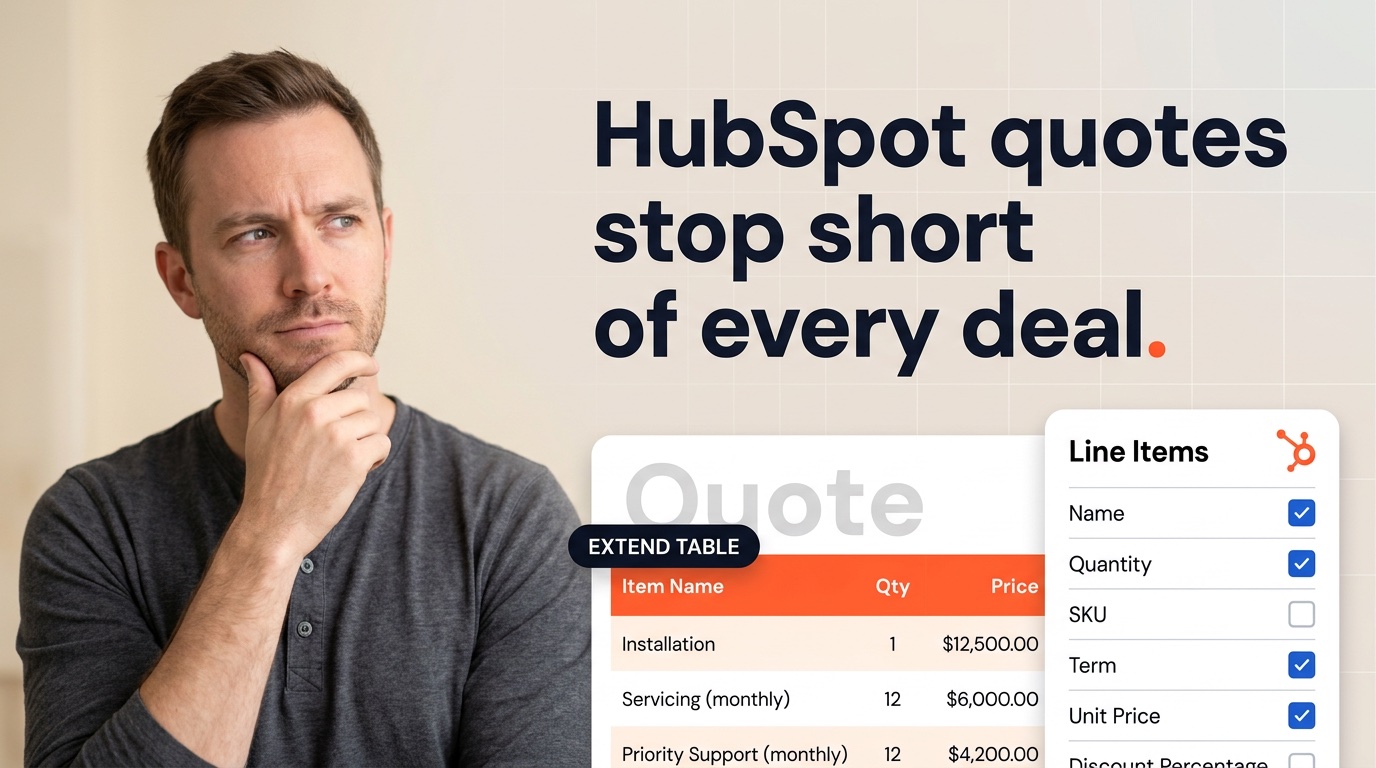
HubSpot Quotes is the built-in quoting tool inside HubSpot Sales Hub. It doesn't require any integration at all because it is HubSpot — quotes pull in deal and line item data, generate a shareable link or PDF, and record acceptance back to the deal record natively. For teams that need basic quoting and are already paying for HubSpot, it costs nothing extra and has zero setup.
Compared to Zoho Sign, HubSpot Quotes actually covers more of the workflow: it generates the document from HubSpot data, not just signs a document you created elsewhere. The limitations are in the other direction — templates are restricted to HubSpot's built-in layouts, there's no advanced approval routing, no built-in eSign without an add-on, and it only covers quotes, not contracts, proposals, or any other document type.
Key features
- Pull deal, contact, and line item data directly — no field mapping required
- Branded quote templates with company logo and colours
- Quote acceptance recorded on the HubSpot deal record
- Payment collection via HubSpot Payments (US) or Stripe integration
- Included with HubSpot Sales Hub Starter, Professional, and Enterprise
Pros
- Zero additional cost if you're already on HubSpot Sales Hub
- Deepest HubSpot data connection of any tool on this list — it's literally native
- No setup, no integration, no Zapier — it's already in your portal
Cons
- Quotes only — not suitable for contracts, NDAs, proposals, or any other document type
- Templates are limited to HubSpot's built-in layouts — your own Google Docs or Word files won't work
- No built-in eSign without a separate HubSpot add-on purchase
- No multi-step approval routing beyond basic HubSpot workflow logic
Pricing: Included at no extra cost with HubSpot Sales Hub Starter ($20/mo+), Professional, and Enterprise. eSign requires a separate HubSpot add-on.
Best for: HubSpot teams that need simple, free quoting right now and want to stay entirely inside HubSpot. Use it as a starting point, then graduate to Portant when you need custom templates, approval workflows, contracts, NDAs, or full document automation triggered by deal stage changes.
 10. Signaturely — best for simple, affordable eSign
G2: 4.8/5 · From $25/mo · Free plan: No (3 free signing requests)
Signaturely is one of the highest-rated eSign tools on G2 and consistently praised for the right reasons: it's genuinely simple, affordable, and focused. Where tools like DocuSign can feel built for enterprise legal departments, Signaturely was designed for small businesses and freelancers who need fast, reliable signing without a steep learning curve or an enterprise price tag.
HubSpot integration is handled via Zapier rather than a native connector — the same situation as Zoho Sign. If the Zapier dependency was part of what frustrated you about Zoho Sign, Signaturely doesn't solve that. But if your primary pain points with Zoho Sign were cost and the Zoho-centric ecosystem, Signaturely is a clean, well-reviewed alternative for eSign only.
Key features
- Upload PDFs and Word files, add signing fields, send in minutes
- Document templates with reusable field placements
- Signing links for one-to-many signing scenarios
- Audit trail and tamper-evident certificates
- HubSpot integration via Zapier
Pros
- Highest G2 rating on this list — consistently praised for simplicity and reliability
- Low price point — affordable for solo operators and small teams
- Fast to set up and learn — most users are collecting signatures the same day
Cons
- No native HubSpot integration — Zapier required, same as Zoho Sign
- No document generation from CRM data — eSign only
- Limited for complex multi-step approval workflows or high-volume automation
Pricing: Personal from ~$25/mo (1 user). Business plan for small teams. Check Signaturely's site for current pricing — rates change frequently. No free plan, but 3 free signing requests available to test.
Best for: small businesses, freelancers, and solo operators who need a reliable, affordable way to collect signatures on existing documents — and whose HubSpot integration needs are light enough that Zapier works fine. Not a step up from Zoho Sign for teams that need native HubSpot connectivity.
How to choose the right tool
The fastest way to narrow this list is to be honest about which problem you're actually trying to solve. Zoho Sign covers one thing: collecting signatures on documents you prepared manually. If that's your workflow and it's working, the question is just whether you want better HubSpot connectivity or lower pricing. If you want better connectivity with similar functionality, Dropbox Sign or SignNow are the most direct swaps. If you want lower pricing, SignNow at $8/user/mo is the cheapest dedicated eSign option.
But if you're shopping because the workflow feels broken — because reps are still building documents by hand, because signed copies aren't landing in HubSpot automatically, because managers can't see document status in their CRM dashboards — then you're not looking for a Zoho Sign replacement. You're looking for a document automation platform that was designed for HubSpot from the beginning.
Where does your team's source of truth live? If HubSpot is the system that managers, ops, and finance actually use to track what's happening in the pipeline, you need a tool that writes document status back to HubSpot as properties — not just activity log entries. Portant and HubSpot Quotes do this natively. Editor-first tools like PandaDoc and Proposify require checking a second dashboard for the real story.
Do you need document generation or just eSign? If your reps are spending time manually building quotes and contracts before sending them for signature, the problem is further upstream than eSign. Tools like Portant, PandaDoc, Proposify, and GetAccept generate documents from your data. DocuSign, Dropbox Sign, SignNow, and Signaturely do not — they're signing layers on top of documents built elsewhere.
How does team size affect your budget? Per-seat pricing compounds as you hire. At five users: PandaDoc ($245/mo), Proposify ($245/mo), DocuSign ($225/mo), Qwilr ($175/mo) vs Portant ($42/mo flat for Pro). At ten users the gap is dramatic. If the team is growing, flat-rate workspace pricing is significantly more predictable.
Quick shortcut: if your team is HubSpot-first and wants documents to behave like CRM records — generated from deal data, tracked in HubSpot, signed and stored without a Zapier bridge — start with Portant. If you want a visual proposal editor and are comfortable with a second dashboard, evaluate PandaDoc or Proposify. If you only need eSign with a direct HubSpot sync, Dropbox Sign or SignNow are clean Zoho Sign upgrades. If you just need free native quotes, HubSpot Quotes is already in your portal.
Frequently asked questions
What is the best Zoho Sign alternative for HubSpot teams?
Portant is the strongest Zoho Sign alternative for HubSpot-first teams. It runs as a certified app inside HubSpot, generates documents from Google Docs or Word templates using live deal data, and saves every signed document back to HubSpot as a record you can filter and report on. Zoho Sign was built for the Zoho CRM ecosystem — for teams on HubSpot, Portant is purpose-built for that workflow without Zapier or manual workarounds.
Why do teams switch from Zoho Sign?
The most common reasons are that Zoho Sign doesn't integrate natively with HubSpot — Zapier is required — it only handles signatures on documents you prepared elsewhere, and there's no automated document generation from CRM data. Teams that want to generate quotes and contracts automatically from HubSpot deal records, route them for approval, collect signatures, and have signed copies land back in HubSpot find that Zoho Sign only covers the last step of a workflow they still have to build manually around it.
Is there a free Zoho Sign alternative for HubSpot?
Yes. Portant has a free plan (up to 30 credits per month) with HubSpot integration included. HubSpot Quotes is also free with any HubSpot Sales Hub plan. HubSpot Quotes is the simplest native option for basic quoting with no setup required. Portant's free plan is better suited to teams wanting to test full document automation — including generation, sending, and eSign — before committing to a paid workspace.
What is the cheapest Zoho Sign alternative?
For pure eSignature, SignNow at $8/user/mo is the cheapest paid option on this list — less than Zoho Sign's Standard plan. For full document automation — generation plus eSign plus native HubSpot integration — Portant at $42/mo for the whole workspace is the most affordable. A five-person team on Portant Pro pays $42/mo flat. The equivalent Zoho Sign setup (Standard plan plus a separate document creation tool plus Zapier) would cost significantly more and involve more moving parts.
Does Zoho Sign integrate natively with HubSpot?
No. Zoho Sign is built for the Zoho CRM ecosystem. Connecting it to HubSpot requires Zapier or a custom integration, and even then HubSpot field data doesn't automatically populate document fields. Teams using Zoho Sign with HubSpot typically maintain two separate platforms with a Zapier bridge — adding cost, fragility, and manual handoffs to the workflow. Tools with native HubSpot integrations like Portant, Dropbox Sign, or SignNow avoid this problem entirely.
Is Portant better than Zoho Sign for HubSpot teams?
For HubSpot teams, yes. Portant is a certified HubSpot app that generates documents from Google Docs or Word templates using live HubSpot data, routes them for approval, collects signatures, and saves signed copies back to the deal record — all inside HubSpot. Zoho Sign covers only the signature step and has no native HubSpot connection. If you're on HubSpot rather than Zoho CRM, Portant handles the complete workflow that Zoho Sign plus a document creation tool plus Zapier would otherwise require.
What is the best Zoho Sign alternative for small businesses?
Portant is the best Zoho Sign alternative for small businesses using HubSpot, because flat workspace pricing means you're not penalised as the team grows. For small businesses that need only basic eSignatures on existing PDFs without deep CRM integration, SignNow or Signaturely are more affordable. HubSpot Quotes covers simple quoting at no additional cost for teams already on Sales Hub. The right answer depends on whether document generation — not just eSign — is part of what you need.