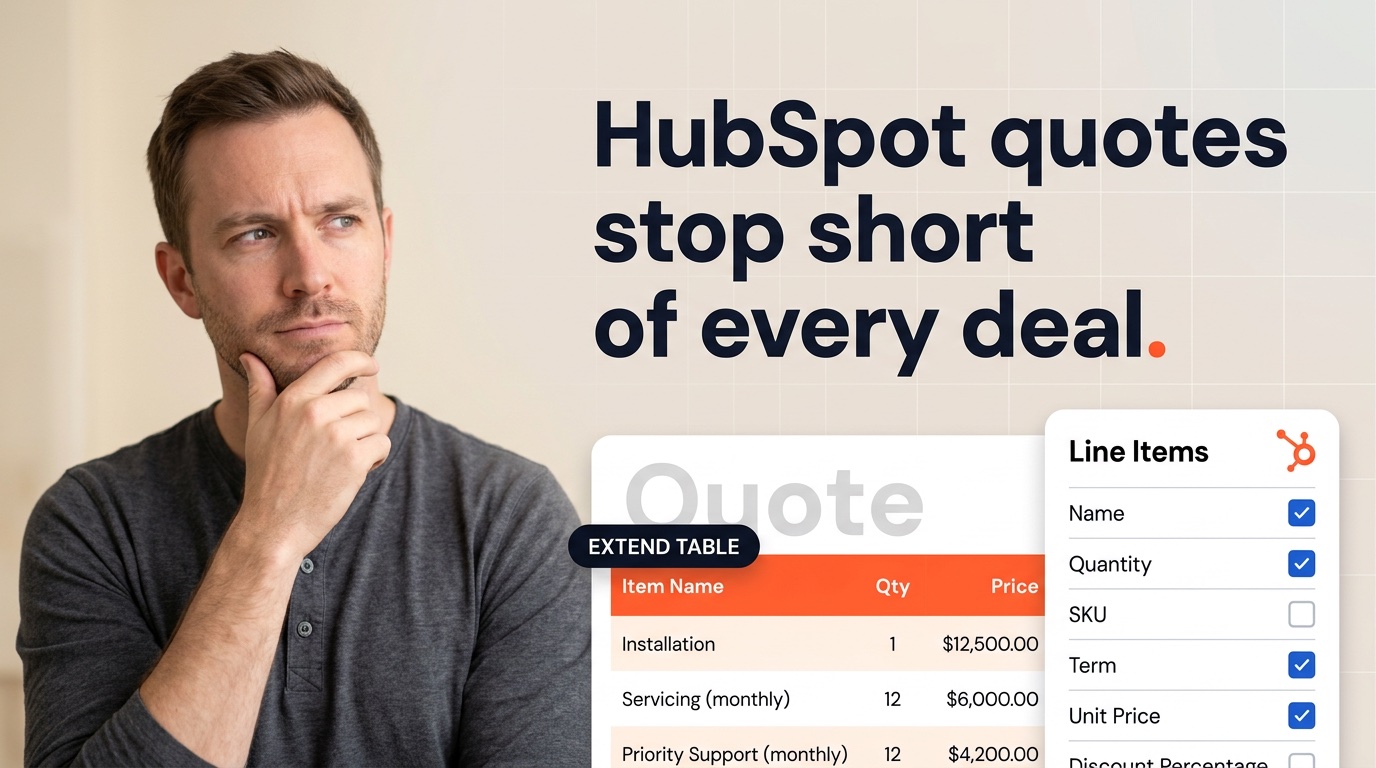


DealHub is a capable CPQ and revenue platform — but most HubSpot teams don't need a CPQ platform. They need to generate a proposal or contract from a deal, route it for approval, and collect a signature. DealHub's full configure-price-quote stack — subscription billing, digital sales rooms, complex pricing rules — is powerful when you genuinely need it. When you don't, it becomes an implementation project that takes weeks to go live, requires professional services, and carries per-seat pricing that compounds fast as the team grows.
I work at Portant, so I'll be transparent about that. But I also spend most of my time inside customer HubSpot portals, and I've seen what actually drives people to look for alternatives. This article evaluates 10 options honestly — including where each one beats Portant and where it doesn't. I've scored them on four criteria: HubSpot integration depth, template flexibility, pricing at a five-user team, and end-to-end document workflow.
Why HubSpot teams look for DealHub alternatives
DealHub is a full CPQ and revenue platform — configure, price, quote plus contract management, digital sales rooms, and subscription billing. For teams that need the full stack it's powerful. For the majority of HubSpot teams who just need to generate a proposal or contract from a deal, route it for approval, and collect a signature, DealHub's scope is overkill and its pricing reflects that.
The first sticking point is implementation. Unlike simpler tools that install from the HubSpot App Marketplace in minutes, DealHub requires product catalog configuration, pricing rule setup, and approval workflow design before it generates a single document. For many teams, this translates to weeks of work — often with paid professional services involved.
The second is pricing opacity. DealHub doesn't publish its rates. You have to enter a sales process just to understand what you'd be spending. Market reports suggest $40–80+/user/month, which means a five-person team could pay $200–400+ per month before factoring in onboarding costs. For teams that just want to send contracts, that's a hard number to justify.
The third is fit. DealHub shines when you have complex product configurations, tiered discounting rules, and multi-step approval matrices. If your team sells a standard service offering, sends custom proposals, and needs contracts to carry HubSpot deal data — that complexity adds friction rather than solving it.
Quick comparison
| Tool | Best for | HubSpot integration | Starting price | Free plan | G2 |
|---|---|---|---|---|---|
| Portant | HubSpot-native doc automation | Native (certified app) | $42/mo workspace | Yes | 4.7/5 |
| PandaDoc | Editor-first proposals + eSign | Integration (sync) | $49/user/mo | No (14-day trial) | 4.7/5 |
| Proposify | Polished proposal creation | Integration (sync) | $49/user/mo | No (14-day trial) | 4.6/5 |
| Qwilr | Interactive web proposals | Integration (sync) | $35/user/mo | No (14-day trial) | 4.5/5 |
| DocuSign | Enterprise eSign compliance | Connector (envelope sync) | $45/user/mo | No (30-day trial) | 4.5/5 |
| GetAccept | Sales engagement + docs | Integration (sync) | Custom pricing | No | 4.6/5 |
| Juro | Legal-led contract management | Integration (sync) | Custom pricing | No | 4.7/5 |
| Conga | Enterprise document automation | Integration (sync) | Custom pricing | No | 4.3/5 |
| HubSpot Quotes | Free native quotes | Native (built into HubSpot) | $0 with Sales Hub | Yes | 4.4/5 |
| Signaturely | Simple, affordable eSign | Via Zapier | From $25/mo | No | 4.8/5 |
G2 ratings as of May 2026. Prices shown are billed annually where applicable — check each vendor's site for current rates.
 1. Portant — best for HubSpot-native document automation
G2: 4.7/5 · From $42/mo workspace · Free plan: Yes
Portant is purpose-built for teams that use HubSpot as their primary system of record and want documents to live there too — not in a separate platform that requires weeks of CPQ configuration before a single document goes out the door. It's the #1 HubSpot-certified document automation app, used by over 920,000 people.
The core difference from DealHub is scope and setup time. DealHub is a revenue intelligence platform — the document generation is one output of a broader configure-price-quote engine that needs product catalogs, pricing rules, and approval matrices configured before it works. Portant takes the opposite approach: connect your HubSpot deal, point it at a Google Docs or Word template, and the document is generated and ready to send. Most teams are generating real documents on the day they install it.
This matters particularly for teams sending proposals and contracts rather than structured product quotes. A custom services proposal, an NDA, a statement of work — none of these fit naturally into a CPQ product catalog. With Portant, these documents use the same templates your team already has in Google Drive or OneDrive. Legal has already approved them. Branding is already right. No rebuilding required.
The HubSpot integration goes deeper than most alternatives. Portant is a certified HubSpot app — it runs from inside your HubSpot portal rather than connecting to it from outside. Every document generated becomes its own HubSpot record with a full timeline: created, sent, viewed, signed. That means deal-stage pipelines, workflow triggers, and management dashboards all reflect document status without anyone opening a second tab or manually updating a field.
For teams with approval requirements — a legal or finance review before contracts go out — Portant's sequential approval workflow handles this natively inside HubSpot. An approver gets a notification, reviews the generated PDF, and approves or rejects with one click. The document status updates on the deal record at every step. No email chains, no separate tool to check.
eSignature is built in on paid plans. Signers receive the document by email, sign on any device, and the signed copy is saved back to the HubSpot deal record automatically. Signing status updates HubSpot at each step — you can build a workflow that moves the deal to Closed Won when all parties have signed, without any manual intervention.
Key features
- Generates documents from live HubSpot deal, contact, company, and line item data
- Templates in Google Docs, Slides, Word, PowerPoint, or PDF — no proprietary editor and no CPQ catalog required
- Every document saved back to HubSpot as its own record with full event history
- Sequential approval workflows with one-click approve/reject from inside HubSpot
- Built-in eSignature on paid plans — status updates HubSpot at each signing step
- Automation triggers: generate documents from deal stage changes, form submissions, or HubSpot workflows
- Conditional content logic — show/hide sections based on HubSpot field values
- Dynamic line item tables pulled directly from HubSpot products
Pros
- Flat workspace pricing means your whole team is covered without per-seat penalties
- No template migration — your existing Google Docs and Word files work from day one
- No CPQ configuration required — works for any document type, not just structured product quotes
- Documents as HubSpot records means reporting, list-building, and workflow automation work natively
- Fast to set up — most teams are generating real documents within hours of installation
Cons
- No visual drag-and-drop builder — if reps want to design rich layouts from scratch inside the tool, the template-file approach feels less visual than DealHub's or Proposify's editor
- Not the right choice if you genuinely need CPQ-level pricing rules, product configurators, and subscription billing — DealHub's structured approach adds real value for that use case
Pricing: Free (30 docs/mo), Pro $42/mo workspace (2,000 docs/mo, billed annually), Team $125/mo for up to 5 users. No per-seat pricing on lower plans — your whole team is included.
For a 5-person team: $125/mo on Portant Team vs an estimated $200–400+/mo on DealHub (pricing not published; sales call required).
For a detailed side-by-side, our Portant vs DealHub comparison page covers features, pricing, and integration depth in full.
 2. PandaDoc — best for editor-first proposals and eSign
G2: 4.7/5 · From $49/user/mo · Free plan: No (14-day trial)
PandaDoc is one of the most established names in document automation. It combines a visual block-based editor, a content library, eSignature, and a payment collection layer in a single platform. For teams switching away from DealHub's CPQ complexity, PandaDoc is often the first alternative they evaluate — and with good reason. It's feature-rich, widely recognised, and has a solid HubSpot integration that syncs deal data in and document status back out.
The HubSpot integration covers field mapping from deals, contacts, and companies into PandaDoc templates, and logs document events — sent, viewed, signed — back to HubSpot activity timelines. Documents live in PandaDoc, not HubSpot, which means reporting on pipeline document status requires checking two places. For teams moving from DealHub's complexity to something simpler, PandaDoc is a significant step down in setup overhead — but the CRM integration depth is shallower than native HubSpot tools.
Key features
- Visual block-based editor with drag-and-drop sections and a reusable content library
- Built-in eSignature with audit trail and multi-signer support
- HubSpot integration: deal data in, activity and document status back out
- Approval workflows and real-time document tracking
- Payment collection via Stripe, PayPal, and other processors
Pros
- Mature platform with a large template library — teams can get up and running quickly
- Visual editor that most reps find easy to use for layout-heavy proposals
- Strong eSign compliance and audit trail for regulated industries
Cons
- Per-seat pricing at $49/user/mo — a five-person team pays $245/mo, comparable to DealHub's lower-end estimates
- Templates must be rebuilt in PandaDoc's editor — existing Google Docs or Word files don't transfer
- Documents live in PandaDoc, not HubSpot — pipeline reporting requires leaving the CRM
Pricing: Essentials plan at $19/user/month covers basic sending. Business plan (the tier required for HubSpot integration, approvals, and custom fields) is $49/user/month. No free plan — 14-day trial available.
Best for: teams that want a polished, editor-first document experience with built-in eSign and payment collection, and are comfortable managing templates in a dedicated platform outside HubSpot.
 3. Proposify — best for polished proposal creation
G2: 4.6/5 · From $49/user/mo · Free plan: No (14-day trial)
Proposify is a dedicated proposal platform built around a visual editor, content library, and collaborative review workflow. Where DealHub focuses on pricing rules and configuration, Proposify focuses on the visual quality of the proposal itself — branded sections, embedded media, interactive pricing tables, and section-level engagement analytics that tell you which parts of the proposal buyers actually read.
The HubSpot integration syncs deal data into proposals and logs activity back to HubSpot, but documents live in Proposify's dashboard. For teams switching from DealHub primarily because of CPQ complexity, Proposify trades one external platform for another — the documents are easier to create, but the CRM reporting story is the same: you need to check Proposify to understand proposal status.
Key features
- Visual block-based editor with drag-and-drop sections and a reusable content library
- E-signature, interactive pricing tables, and video embedding built in
- Approval workflows and real-time viewer notifications
- HubSpot integration: deal data in, activity and status back out
- Section-level analytics: scroll depth, time spent, and signer activity
Pros
- Polished editor — most reps find it easier to produce design-forward proposals than in DealHub or PandaDoc
- Strong content library for teams that need consistent branded sections across many proposals
- Detailed analytics — more visibility into buyer engagement than most alternatives
Cons
- Per-seat pricing at $49/user/mo — a five-person team pays $245/mo, which doesn't solve DealHub's cost problem
- Documents live in Proposify, not HubSpot — managers still need a second dashboard for pipeline document status
- Content library requires ongoing admin effort to maintain properly
Pricing: Team plan at $49/user/month (billed annually). Includes HubSpot integration, approvals, and analytics. No free plan — 14-day trial available.
Best for: teams that want a polished, editor-first proposal experience and have admin time to maintain a content library. If you're switching from DealHub because it was too complex, note that Proposify's per-seat pricing doesn't represent a significant cost saving.
 4. Qwilr — best for interactive web-based proposals
G2: 4.5/5 · From $35/user/mo · Free plan: No (14-day trial)
Qwilr takes a distinctive approach to proposals: instead of generating a PDF or Word document, buyers receive a responsive, branded webpage. They can navigate sections, engage with interactive pricing tables, accept online, and sign — all in the browser without downloading anything. For teams where the proposal experience is part of the pitch, the format itself becomes a differentiator against competitors still sending flat PDFs.
The HubSpot integration is similar in depth to Proposify: deal data flows into the template, and view, acceptance, and signing events sync back. At $35/user/month Qwilr is moderately cheaper than Proposify or PandaDoc at the same feature level — but still per-seat pricing, and documents live in Qwilr rather than HubSpot.
Key features
- Web-based proposal format — interactive, mobile-responsive, no PDF required
- Section-level engagement analytics: which parts buyers read, time spent, scroll depth
- Online acceptance and eSign without an email attachment
- HubSpot integration: deal data in, engagement data and status back out
- Interactive pricing tables with buyer-selectable options
Pros
- Modern buyer experience that stands out against PDF-based competitors
- Section analytics give sales reps visibility that static documents simply can't provide
- Lower per-seat price than Proposify or PandaDoc at comparable feature tiers
Cons
- Not all buyers prefer web proposals — procurement teams often require a PDF for internal approvals
- No offline option: if a buyer's internet connection is unreliable, the proposal becomes inaccessible
- Documents don't live in HubSpot — CRM reporting requires going into Qwilr
Pricing: Business plan at $35/user/month (billed annually). Includes HubSpot integration, eSign, and analytics. No free plan — 14-day trial available.
Best for: creative agencies, high-touch SaaS, and professional services teams where the proposal moment is a key part of the sale and buyers expect a modern digital experience over a traditional PDF.
 5. DocuSign — best for enterprise eSign compliance
G2: 4.5/5 · From $45/user/mo · Free plan: No (30-day trial)
DocuSign is the category standard for electronic signatures. If your use case is specifically about compliant, auditable signatures on documents that are already finalised elsewhere — and enterprise buyer recognition matters — DocuSign is the safest choice. Almost every procurement team and large enterprise buyer recognises a DocuSign envelope, and its compliance certifications cover the most demanding regulated industries.
The critical thing to understand is what DocuSign doesn't do: it doesn't generate documents from CRM data. You upload a finished PDF or Word document, add signature fields, and send. The HubSpot connector syncs envelope status back — sent, viewed, completed, declined — but it's a narrower integration than a full document automation tool. If you're replacing DealHub's document generation alongside its eSign, DocuSign only covers half the workflow.
Key features
- Industry-standard eSign with SOC 2, ISO 27001, eIDAS, and ESIGN Act compliance
- Granular audit trail — IP address, timestamp, and signer identity for every action
- HubSpot connector: envelope events sync back to deal or contact records
- In-person signing and SMS-based identity verification on higher plans
- Bulk send for high-volume agreement scenarios
Pros
- Widest enterprise recognition — buyers and procurement teams expect it
- Best-in-class compliance certifications for regulated industries
- Reliable and mature platform with a large integrations ecosystem
Cons
- Does not replace DealHub as a document generation tool — it only covers the eSign step
- HubSpot integration is connector-level: envelope status syncs, but documents don't live as HubSpot records
- Expensive relative to capabilities if you're mainly using it for basic contract signing workflows
Pricing: Standard at $45/user/month (billed annually). Business Pro at $65/user/month. Enterprise pricing by contract. No free plan — 30-day trial available.
Best for: enterprise teams in regulated industries where buyer recognition and compliance certification are requirements, and where documents are already finalised in another system before signature is needed.
 6. GetAccept — best for sales engagement plus documents
G2: 4.6/5 · Custom pricing · Free plan: No
GetAccept combines document automation with sales engagement features — video messaging embedded in proposals, live chat accessible within the document, and detailed buyer-side engagement tracking throughout the deal cycle. It's positioned as more than a document tool: the idea is to keep prospects engaged between touchpoints, not just at the moment they receive something to sign.
For teams moving from DealHub specifically because of CPQ overhead, GetAccept offers a middle ground — capable document creation without a CPQ product catalog, but with engagement features that go beyond what Portant or PandaDoc offer. Pricing is custom and requires a demo call, which positions it similarly to DealHub on the "you need a sales conversation to understand cost" front.
Key features
- Document editor with embedded video, live chat, and real-time engagement notifications
- Contract management with clause library and redlining support
- Built-in eSign with detailed audit trail
- HubSpot integration: deal data in, activity and document status back out
- Buyer-side engagement tracking — see when, how long, and which sections they reviewed
Pros
- Unique combination of engagement tools (video, chat) alongside document automation
- Strong for complex, multi-stakeholder deals where buyer engagement between touchpoints is uncertain
- Solid audit trails and contract management for teams with legal requirements
Cons
- Custom pricing means no self-serve — you need a sales conversation to understand cost, which is similar friction to DealHub
- The engagement feature set adds complexity that's overkill for teams sending standard contracts or quotes
- Less HubSpot-native than tools built specifically for the HubSpot ecosystem
Pricing: Custom — requires a demo. Generally mid-market and up. No published per-seat rate.
Best for: mid-market sales teams with long deal cycles, multiple stakeholders, and a genuine need to track buyer engagement between touchpoints — not teams looking for a simpler, faster alternative to DealHub's complexity.
 7. Juro — best for legal-led contract management
G2: 4.7/5 · Custom pricing · Free plan: No
Juro is a contract lifecycle management platform built around a collaborative browser-based editor where sales, legal, and counterparties can all negotiate in the same document in real time. It's a step up in CLM sophistication — designed for organisations where legal is an active participant in every commercial deal, not just a one-time reviewer before the signature goes out.
For teams coming from DealHub, Juro solves a different problem. DealHub handles pricing complexity; Juro handles contract negotiation complexity. If your bottleneck is redlining, clause management, and version control — rather than CPQ configuration — Juro addresses that directly. The HubSpot integration generates contracts from deal data and syncs signed status back. Custom pricing and a sales-led process mean it's sized for organisations with genuine CLM needs.
Key features
- Browser-based collaborative editor with real-time redlining and clause negotiation
- Pre-approved clause library for legal teams to standardise language across all deals
- Contract lifecycle tracking — drafts, in review, out for signature, signed, renewals
- eSign with full audit trail and signer verification
- HubSpot integration: generate from deals, sync contract status back
Pros
- Best-in-class collaborative redlining — counterparties can negotiate directly in the document without email attachments
- Clause library gives legal real control over what language leaves the organisation
- Strong for teams managing large contract volumes with renewals, amendments, and version control
Cons
- Enterprise pricing and a sales-led process — not suitable for small teams or self-serve evaluation
- More complexity than most HubSpot sales teams need if contracts are standard and rarely negotiated
- Documents live in Juro, not HubSpot — pipeline reporting still requires switching tools
Pricing: Custom — Juro doesn't publish rates publicly. Positioned at mid-market and enterprise. Expect a sales process.
Best for: companies with active legal involvement in commercial deals and a genuine need for contract negotiation, version control, and renewal management — not straightforward send-and-sign workflows where simpler tools will do.
 8. Conga — best for enterprise document automation at scale
G2: 4.3/5 · Custom pricing · Free plan: No
Conga is an enterprise document automation and CLM platform with a long history — originally built on Salesforce, it has since expanded to cover HubSpot and other CRMs. It covers the full document lifecycle: generation from CRM data, approval workflows, eSignature, and contract management. At the enterprise tier, it's a serious platform with deep configuration capabilities.
For teams evaluating DealHub alternatives, Conga is positioned at a similar level of enterprise complexity — it's not a simpler solution, it's a different enterprise solution. Its G2 rating (4.3/5) is the lowest on this list, with reviewers frequently citing implementation complexity, a steep learning curve, and a product that reflects its Salesforce heritage more than its HubSpot integration work. Teams specifically on HubSpot often find the native experience less polished than tools built for HubSpot from the ground up.
Key features
- Document generation from CRM data with complex conditional logic and merge fields
- Contract lifecycle management with approval routing and redlining
- Built-in eSignature (Conga Sign) or integrations with DocuSign and Adobe Sign
- HubSpot integration: deal and contact data in, document and contract status back out
- High-volume bulk document generation for enterprise workflows
Pros
- Handles genuinely complex document generation scenarios with advanced merge logic
- Full CLM capabilities for teams that need more than basic send-and-sign
- Enterprise-grade security and compliance certifications
Cons
- Lowest G2 rating on this list — users consistently cite implementation complexity and UX friction
- Custom pricing and a sales-led process; implementation typically requires professional services
- Roots in the Salesforce ecosystem mean the HubSpot integration is less native than HubSpot-first tools
Pricing: Custom — requires a sales process. Conga is enterprise-focused and pricing depends on modules, users, and document volume. No free plan or published starting rates.
Best for: large enterprises with complex document automation requirements across a multi-CRM or multi-system environment, and internal resources to manage the implementation. Not the right choice for teams switching from DealHub because they want something simpler.
 9. HubSpot Quotes — best for free native quoting
G2: 4.4/5 (Sales Hub) · $0 with Sales Hub · Free plan: Yes
HubSpot Quotes is the built-in quoting tool inside HubSpot Sales Hub. It doesn't require a third-party integration because it is HubSpot — quotes pull in deal and line item data, generate a shareable link or PDF, and record acceptance back to the deal record natively. For teams that need basic quoting and are already paying for HubSpot, it costs nothing extra.
The limitations matter if you're coming from DealHub's full feature set. HubSpot Quotes handles simple, structured quotes with line items and pricing — it's not built for custom proposals, contracts, NDAs, or statements of work. There's no complex conditional content, no multi-step approval routing beyond basic HubSpot workflow logic, and no eSign without additional HubSpot add-ons. It's quoting, not document automation.
Key features
- Pull deal, contact, and line item data directly — no mapping or configuration required
- Branded quote templates with your company logo and colours
- Quote acceptance recorded directly on the HubSpot deal record
- Payment collection via HubSpot Payments (US) or Stripe integration
- Included with HubSpot Sales Hub Starter, Professional, and Enterprise
Pros
- Zero additional cost if you're already on HubSpot Sales Hub
- Deepest HubSpot data connection of any tool on this list — it's genuinely native
- No setup, no integration configuration, no third-party tool to manage
Cons
- Quotes only — not suitable for contracts, proposals, NDAs, or any non-quote document
- Templates are limited — no support for your own Google Docs or Word layouts
- No built-in eSign without additional HubSpot add-ons at extra cost
- No multi-step approval routing for legal or finance review
Pricing: Included at no extra cost with HubSpot Sales Hub Starter ($20/mo+), Professional, and Enterprise. eSign requires a separate HubSpot add-on.
Best for: HubSpot teams that need simple, structured quotes only and want the zero-cost option before investing in a dedicated document automation tool. Use it to establish your baseline workflow, then move to Portant when you need custom templates, approval routing, contracts, or full eSign.
 10. Signaturely — best for simple, affordable eSign
G2: 4.8/5 · From $25/mo · Free plan: No
Signaturely is one of the highest-rated eSign tools on G2 and it earns that rating by being genuinely simple and affordable. Where DealHub, DocuSign, and Conga can feel like they were built for enterprise legal departments, Signaturely was designed for small businesses and freelancers who need fast, reliable signing without a steep learning curve or a sales call to get started.
It's worth being clear about scope: Signaturely is an eSign tool, not a document generation platform. You upload a PDF or Word document you've already prepared, add signing fields, and send. It doesn't pull data from HubSpot deals to populate documents automatically. If you're replacing DealHub's full document workflow, Signaturely only covers the final signature step — you'd still need to handle document creation separately. HubSpot integration is via Zapier rather than a native connector, which adds setup friction for teams that want tight CRM workflow automation.
Key features
- Upload PDFs and Word files, add signing fields, send in minutes
- Document templates with reusable field placements for recurring agreements
- Signing links for one-to-many signing scenarios without individual sends
- Audit trail and tamper-evident certificates on all completed documents
- HubSpot integration via Zapier
Pros
- Highest G2 rating on this list at 4.8/5 — consistently praised for simplicity and reliability
- Low price point — genuinely affordable for solo operators and very small teams
- Fast to set up and learn — most users are collecting signatures the same day they sign up
Cons
- No native HubSpot integration — Zapier required, which adds cost and setup complexity
- No document generation from CRM data — eSign only, not a DealHub replacement for the full workflow
- Limited for complex multi-step approval workflows or high-volume enterprise scenarios
Pricing: Personal plan from ~$25/mo (1 user). Business plan available for small teams. Check Signaturely's site for current pricing — rates can change. No free plan, but limited free signing requests to test before committing.
Best for: small businesses, freelancers, and solo operators who need a reliable, affordable way to collect signatures on documents they've already created — without the overhead of a full document automation platform or CPQ engine.
How to choose the right tool
If you're coming from DealHub, the first question isn't which alternative has the most features — it's which alternative actually solves the problem you had with DealHub. That usually comes down to three things.
Do you need CPQ or document automation? DealHub is a CPQ platform. If your evaluation of alternatives revealed that CPQ was the right category all along — complex product configurations, tiered discounting, subscription billing — then your alternatives are other CPQ tools and the comparison is different from what's covered here. If you discovered that CPQ was overkill and you primarily need to generate proposals and contracts from HubSpot data, then tools like Portant, PandaDoc, and Proposify are the right category. Know which problem you're actually solving.
Where does your team's source of truth live? If HubSpot is the system managers, ops, and finance actually use to track pipeline, you need a tool that writes document status back to HubSpot as properties — not just activity log entries. Portant and HubSpot Quotes do this natively. Editor-first tools like Proposify and Qwilr require checking a second dashboard for the real picture, which is the same CRM fragmentation that frustrated many DealHub users.
How does pricing scale as the team grows? Per-seat pricing compounds. At five users: PandaDoc Business ($245/mo), Proposify ($245/mo), DocuSign Standard ($225/mo), Qwilr ($175/mo) vs Portant Team ($125/mo flat). If the team is growing, flat-rate tools become increasingly advantageous. DealHub's undisclosed per-seat pricing is what drove many teams to look for alternatives in the first place — switching to another per-seat tool with a visible price tag doesn't fundamentally change that calculus.
Quick shortcut: if your team is HubSpot-first and wants documents to behave like CRM records without CPQ overhead, start with Portant. If you need a visual builder and are comfortable with a second dashboard, evaluate Proposify or PandaDoc. If you need enterprise eSign compliance on pre-built documents, DocuSign or Signaturely cover that. If you genuinely need CLM with legal redlining, Juro is purpose-built for it. If you just need free quotes, HubSpot Quotes is already in your portal.
Frequently asked questions
What is the best DealHub alternative for HubSpot teams?
Portant is the strongest DealHub alternative for HubSpot-first teams. It runs as a certified app inside HubSpot, lets you keep templates in Google Docs or Word, and saves every document back to HubSpot as a record you can filter and report on. For teams who need to generate proposals and contracts from HubSpot deal data without configuring a full CPQ platform, Portant is purpose-built for that workflow.
Why do teams switch from DealHub?
The most common reasons are implementation complexity, required professional services, and per-seat costs that outweigh the benefit for teams who mainly need to generate a proposal or contract from a deal and collect a signature. DealHub is a full CPQ and revenue platform — powerful when you need the full stack, but overkill for teams doing straightforward HubSpot-driven document generation. The implementation timeline alone — typically several weeks — is a dealbreaker for many teams.
Is there a free DealHub alternative?
Yes. Portant has a free plan (up to 30 documents per month) and HubSpot Quotes is free with any HubSpot Sales Hub plan. DealHub has no free plan and requires a sales call to even understand pricing. Portant's free plan covers small teams testing document automation before committing to a paid workspace, and HubSpot Quotes covers basic quoting at no cost if you're already on Sales Hub.
What is the cheapest DealHub alternative?
Portant is the cheapest full-featured DealHub alternative for HubSpot teams. Its Pro plan is $42/month for the entire workspace — not per user. DealHub doesn't publish pricing, but market reports suggest $40–80+/user/month depending on features and team size. A five-person team could pay $200–400+ per month on DealHub versus $42/month on Portant Pro. HubSpot Quotes is free but limited to basic quoting with no custom templates or eSign built in.
Is Portant better than DealHub for HubSpot teams?
For teams that primarily need to generate proposals, contracts, and NDAs from HubSpot deal data, Portant is the better fit. It installs in minutes from the HubSpot App Marketplace, uses your existing Google Docs templates without any CPQ catalog configuration, and saves every document back to HubSpot as a record workflows and reports can act on. DealHub is the better choice when you have genuinely complex configure-price-quote requirements — multiple product bundles, tiered discounting rules, and subscription billing — where the CPQ infrastructure adds real value rather than friction.
Does DealHub work with Google Docs templates?
No. DealHub generates documents from a structured CPQ product catalog and pricing rules — not from Google Docs, Slides, or Word templates you design yourself. Teams that want custom-format documents using their own layouts should use Portant, which uses your existing Google Docs and Word files directly without any proprietary editor or catalog setup required.
What is the best DealHub alternative for small businesses?
Portant is the best DealHub alternative for small businesses using HubSpot. Flat-rate workspace pricing means you're not penalised as the team grows, and setup takes minutes rather than weeks of CPQ configuration. For small businesses that only need basic eSignatures on existing PDFs without document generation, Signaturely is the most affordable option on this list. HubSpot Quotes covers simple quoting at no additional cost if you're already on Sales Hub.